Batista Stops Power Again and Is in Charge of Oppressive and Corrupt of Regime
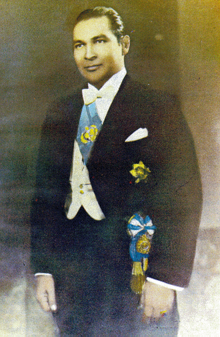
| Fulgencio Batista | |
|---|---|
 | |
| 14th and 17th President of Republic of cuba | |
| In role March 10, 1952 – January 1, 1959 | |
| Prime Minister |
|
| Vice President | Rafael Guas Inclán |
| Preceded by | Carlos Prío Socarrás |
| Succeeded past | Anselmo Alliegro |
| In part October 10, 1940 – October 10, 1944 | |
| Prime Minister |
|
| Vice President | Gustavo Cuervo Rubio |
| Preceded by | Federico Laredo Brú |
| Succeeded by | Ramón Grau |
| Cuban Senator | |
| In office June ii, 1948 – March 10, 1952 | |
| Constituency | Las Villas |
| Personal details | |
| Born | Rubén Zaldívar (1901-01-xvi)January 16, 1901 Banes, Republic of cuba |
| Died | August 6, 1973(1973-08-06) (anile 72) Marbella, Málaga, Spanish State |
| Resting identify | Saint Isidore Cemetery |
| Political party |
|
| Spouse(s) | Elisa Godínez Gómez (one thousand. 1926; div. 1946) Marta Fernandez Miranda (m. 1946) |
| Children | 9 |
| Other names | Fulgencio Batista y Zaldívar (full name from 1939) |
| Military service | |
| Allegiance |  Cuba Cuba |
| Branch/service | Cuban Regular army |
| Years of service | 1921–1940 |
| Rank | Colonel |
Fulgencio Batista y Zaldívar (;[one] Spanish: [fulˈxensjo βaˈtista i salˈdiβaɾ]; born Rubén Zaldívar,[2] January 16, 1901 – August 6, 1973) was a Cuban military officer and politician who served equally the elected president of Cuba from 1940 to 1944 and every bit its U.S.-backed military dictator from 1952 to 1959, when he was overthrown by the Cuban Revolution.
Batista initially rose to ability every bit part of the 1933 Revolt of the Sergeants, which overthrew the provisional government of Carlos Manuel de Céspedes y Quesada. Batista and so appointed himself principal of the armed services, with the rank of colonel, and finer controlled the five-fellow member "pentarchy" that functioned as the collective head of state. He maintained control through a cord of puppet presidents until 1940, when he was elected president on a populist platform.[3] [4] He then instated the 1940 Constitution of Cuba[5] and served until 1944. After finishing his term, Batista moved to Florida, returning to Cuba to run for president in 1952. Facing certain balloter defeat, he led a military coup against President Carlos Prío Socarrás that pre-empted the election.[6]
Back in power and receiving financial, military and logistical back up from the United States government,[7] [viii] Batista suspended the 1940 Constitution and revoked most political liberties, including the right to strike. He then aligned with the wealthiest landowners who endemic the largest carbohydrate plantations, and presided over a stagnating economic system that widened the gap between rich and poor Cubans.[ix] Eventually it reached the betoken where most of the saccharide manufacture was in U.S. hands, and foreigners endemic lxx% of the arable land.[10] As such, Batista's repressive government and so began to systematically profit from the exploitation of Republic of cuba'south commercial interests, by negotiating lucrative relationships both with the American Mafia, who controlled the drug, gambling, and prostitution businesses in Havana, and with large U.S.-based multinational companies who were awarded lucrative contracts.[9] [eleven] To quell the growing discontent amongst the populace—which was subsequently displayed through frequent student riots and demonstrations—Batista established tighter censorship of the media, while likewise utilizing his Bureau for the Repression of Communist Activities hugger-mugger police force to carry out wide-scale violence, torture and public executions. These murders mounted in 1957, as socialist ideas became more than influential. Many people were killed, with estimates ranging from hundreds to about 20,000 people killed.[12] [thirteen] [14] [15] [16] [17] [18]
These tactics ultimately failed to quell unrest and instead were the catalyst for more than widespread resistance. For two years (December 1956 – December 1958) Fidel Castro's 26th of July Movement and other rebelling elements led an urban- and rural-based guerrilla uprising confronting Batista's authorities, which culminated in his eventual defeat past rebels under the command of Che Guevara at the Battle of Santa Clara on New year's day's Day 1959. Batista immediately fled the isle with an amassed personal fortune to the Dominican Republic, where strongman and previous military ally Rafael Trujillo held power. Batista somewhen plant political asylum in Oliveira Salazar's Portugal, where he first lived on the island of Madeira and so in Estoril. He was involved in business concern activities in Spain and was staying there in Guadalmina at the fourth dimension of his death from a heart set on on Baronial half-dozen, 1973.[xix]
Early life [edit]
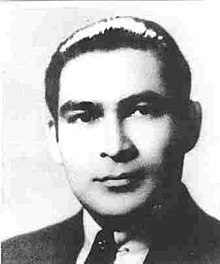
Batista was built-in in the town of Veguita, located in the municipality of Banes, Cuba in 1901 to Belisario Batista Palermo[twenty] and Carmela Zaldívar González, who had fought in the Cuban War of Independence. He was of Castilian, African, Chinese, and possibly some Taíno descent.[21] [22] [23] His female parent named him Rubén and gave him her last proper noun, Zaldívar. His father did not want to register him as a Batista. In the registration records of the Banes courthouse, he was legally Rubén Zaldívar until 1939, when, as Fulgencio Batista, he became a presidential candidate and it was discovered that this name did not be in the nascency certificates; he thus had to postpone the presentation of his candidacy and pay xv,000 pesos to the local estimate.[2]
Both Batista's parents are believed to have been of mixed race and one may take had Indigenous Caribbean blood.[24] Batista was initially educated at a public schoolhouse in Banes and later attended night classes at an American Quaker school.[25] He left home at age 14, after the death of his female parent. Coming from a apprehensive background, he earned a living as a laborer in the cane fields, docks, and railroads.[26] He was a tailor, mechanic, charcoal vendor and fruit peddler.[26] In 1921, he traveled to Havana, and in Apr joined the regular army as a private.[27] After learning autograph and typing, Batista left the army in 1923, working briefly every bit a instructor of stenography before enlisting in the Guardia Rural (rural police). He transferred back to the regular army equally a corporal, becoming secretarial assistant to a regimental colonel.[28] In September 1933, he held the rank of sergeant stenographer and as such acted every bit the secretary of a group of not-commissioned officers who led a "sergeants' conspiracy" for better conditions and improved prospects of promotion.[29]
1933 insurrection [edit]

The Pentarchy of 1933 was a five-man Presidency of Cuba, including José M. Irisari, Porfirio Franca, Guillermo Portela, Ramón Grau, and Sergio Carbó. Batista (on the far right) controlled the armed forces.
In 1933, Batista led an insurgence called the Sergeants' Revolt, equally part of the coup that overthrew the government of Gerardo Machado.[30] Machado was succeeded past Carlos Manuel de Céspedes y Quesada, who lacked a political coalition that could sustain him and was presently replaced.[31]
A short-lived five-member presidency, known every bit the Pentarchy of 1933, was established. The Pentarchy included a representative from each anti-Machado faction. Batista was non a fellow member, but controlled Cuba's armed forces. Inside days, the representative for the students and professors of the University of Havana, Ramón Grau San Martín, was fabricated president—and Batista became the Army Main of Staff, with the rank of colonel, effectively putting him in control of the presidency.[32] The majority of the deputed officer corps were forced to retire or, some speculate, were killed.[32]

Grau remained president for just over 100 days before Batista, conspiring with the U.Southward. envoy Sumner Welles, forced him to resign in January 1934.[30] Grau was replaced by Carlos Mendieta, and within five days the U.Southward. recognized Republic of cuba'southward new government, which lasted eleven months. Batista then became the strongman behind a succession of puppet presidents until he was elected president in 1940.[30] After Mendieta, succeeding governments were led by José Agripino Barnet (five months) and Miguel Mariano Gómez (seven months) earlier Federico Laredo Brú ruled from December 1936 to October 1940.[31]
Outset presidency (1940–1944) [edit]
Fulgencio Batista portrait, 1940
Batista, supported past the Democratic Socialist Coalition which included Julio Antonio Mella'south Communist Party, defeated Grau in the commencement presidential ballot under the new Cuban constitution in the 1940 ballot, and served a iv-year term as President of Cuba, the commencement and to this twenty-four hour period but, non-white Cuban in that role.[33] [34] Batista was endorsed by the original Communist Political party of Cuba (later known as the Pop Socialist Party), which at the time had little significance and no probability of an electoral victory.[34] This support was primarily due to Batista's labor laws and his support for labor unions, with which the Communists had shut ties.[35] In fact, Communists attacked the anti-Batista opposition, saying Grau and others were "fascists" and "reactionaries."[36] During this term in office, Batista carried out major social reforms[34] and established numerous economical regulations and pro-matrimony policies.[36]
Cuba entered Globe War II on the side of the Allies on Dec nine, 1941, declaring state of war on Nippon two days after the attack on Pearl Harbor. On December 11, the Batista government alleged war on Germany and Italian republic. In December 1942, afterwards a friendly visit to Washington, Batista said Latin America would applaud if the Announcement by United Nations called for state of war with Francisco Franco'southward Spain, calling the regime "fascist".[37] [38]
Mail-presidency [edit]
In 1944, Batista'south handpicked successor, Carlos Saladrigas Zayas,[39] was defeated past Grau. In the final months of his presidency, Batista sought to handicap the incoming Grau administration. In a July 17, 1944, dispatch to the U.S. Secretarial assistant of State, U.Due south. Administrator Spruille Braden wrote:
It is becoming increasingly apparent that President Batista intends to discomfit the incoming Assistants in every style possible, particularly financially. A systematic raid on the Treasury is in full swing with the result that Dr. Grau will probably notice empty coffers when he takes office on Oct 10. Information technology is blatant that President Batista desires that Dr. Grau San Martin should presume obligations which in fairness and equity should be a thing of settlement by the present Administration.[40]
Shortly after, Batista left Cuba for the U.s.a.. "I just felt safer there," he said. He divorced his wife, Elisa, and married Marta Fernández Batista in 1945. Two of their four children were born in the U.s.a..
For the next 8 years, Batista remained in the background, spending fourth dimension in the Waldorf-Astoria in New York Metropolis and a home in Daytona Beach, Florida.[thirty]
He continued to participate in Cuban politics, and was elected to the Cuban Senate in absentia in 1948. Returning to Cuba, he decided to run for president and received permission from President Grau, whereupon he formed the United Action Party. On taking power he founded the Progressive Activity Political party, but he never regained his former popular support, though the unions supported him until the end.[41] [42]
Military machine coup and 2d presidency (1952–1959) [edit]

Slum (bohio) dwellings in Havana, Cuba in 1954, just outside Havana baseball stadium. In the groundwork is advertizement for a nearby casino.
In 1952, Batista again ran for president. In a three-manner race, Roberto Agramonte of the Orthodox Political party led in all the polls, followed by Carlos Hevia of the Authentic Party. Batista'south United Action coalition was running a distant third.[43] [44]
On March ten, 1952, three months before the elections, Batista, with army backing, staged a coup and seized ability. He ousted approachable President Carlos Prío Socarrás, canceled the elections and took control of the regime equally a provisional president. The United States recognized his government on March 27.[45] When asked by the U.S. regime to analyze Batista's Cuba, Arthur Thou. Schlesinger, Jr. said
The corruption of the Government, the brutality of the police, the government's indifference to the needs of the people for education, medical care, housing, for social justice and economic justice ... is an open invitation to revolution.[46]
Economy of Republic of cuba [edit]
Upon his seizure of power, Batista inherited a land that was relatively prosperous for Latin America. Co-ordinate to Batista'south government, although a tertiary of Cubans yet lived in poverty, Cuba was 1 of the 5 about adult countries in the region.[47] In the 1950s, Republic of cuba's gross domestic product (Gross domestic product) per capita was roughly equal to that of Italy at the fourth dimension, although still but a sixth of that of the U.s.a..[48] Moreover, although abuse and inequality were rife under Batista, Cuban industrial workers' wages rose significantly. In 1953, the boilerplate Cuban family unit but had an income of $half-dozen.00 a week, fifteen% to 20% of the labor forcefulness was chronically unemployed, and but a third of the homes had running water.[49] [ not-primary source needed ]. [48] Despite this, according to the International Labour Organization, the average industrial salary in Cuba became the globe'due south eighth-highest in 1958, and the average agricultural wage was college than some European nations.
Relationship with organized criminal offence [edit]
Brothels flourished. A major industry grew up effectually them; government officials received bribes, policemen collected protection coin. Prostitutes could be seen continuing in doorways, strolling the streets, or leaning from windows. One report estimated that 11,500 of them worked their trade in Havana. Across the outskirts of the capital, across the slot machines, was one of the poorest, and most beautiful countries in the Western world.
—David Detzer, American announcer, after visiting Havana in the 1950s [50]
Throughout the 1950s, Havana served as "a hedonistic playground for the earth's elite", producing sizable gambling, prostitution and drug profits for the American mafia, corrupt police force-enforcement officials, and their politically elected cronies.[51] In the cess of the Cuban-American historian Louis Perez, "Havana was and so what Las Vegas has become."[52] Relatedly, information technology is estimated that by the end of the 1950s the metropolis of Havana had 270 brothels.[53] In improver, drugs, be it marijuana or cocaine, were then plentiful at the time that one American magazine in 1950 proclaimed "Narcotics are inappreciably more difficult to obtain in Cuba than a shot of rum. And merely slightly more expensive."[51] Every bit a result, the playwright Arthur Miller described Batista's Cuba in The Nation as "hopelessly corrupt, a Mafia playground, (and) a bordello for Americans and other foreigners."[54]
In a bid to profit from such an environment, Batista established lasting relationships with organized offense, notably with American mobsters Meyer Lansky and Lucky Luciano, and under his rule Havana became known as "the Latin Las Vegas".[55] Batista and Lansky formed a friendship and business human relationship that flourished for a decade. During a stay at the Waldorf-Astoria in New York in the tardily 1940s, it was mutually agreed that, in return for kickbacks, Batista would requite Lansky and the Mafia control of Havana's racetracks and casinos.[56] Afterward World State of war 2, Luciano was paroled from prison on the condition that he permanently return to Sicily. Luciano secretly moved to Republic of cuba, where he worked to resume control over American Mafia operations. Luciano also ran a number of casinos in Cuba with the sanction of Batista, though the American government somewhen succeeded in pressuring the Batista government to bear him.[57]
Batista encouraged big-calibration gambling in Havana. In 1955, he announced that Cuba would grant a gaming license to anyone who invested Usa$1 million in a hotel or $200,000 in a new nightclub—and that the government would provide matching public funds for construction, a x-twelvemonth tax exemption, and waive duties on imported equipment and furnishings for new hotels. Each casino would pay the government $250,000 for the license, plus a percentage of the profits. The policy omitted background checks, as required for casino operations in the United States, which opened the door for casino investors with illegally obtained funds. Cuban contractors with the right connections fabricated windfalls by importing, duty-free, more materials than needed for new hotels and selling the surplus to others. Information technology was rumored that, besides the $250,000 to obtain a license, an additional "under the tabular array" fee was sometimes required.[58]
Lansky became a prominent effigy in Cuba's gambling operations,[30] and exerted influence over Batista's casino policies. The Mafia's Havana Briefing was held on Dec 22, 1946, at the Hotel Nacional de Republic of cuba; this was the first full-scale meeting of American underworld leaders since the Chicago meeting in 1932. Lansky gear up about cleaning up the games at the Montmartre Guild, which presently became the "place to be" in Havana. He besides wanted to open up a casino in the Hotel Nacional, the well-nigh elegant hotel in Havana. Batista endorsed Lansky's idea over the objections of American expatriates such as Ernest Hemingway, and the renovated casino wing opened for business in 1955 with a show past Eartha Kitt. The casino was an immediate success.[59]
Every bit the new hotels, nightclubs, and casinos opened, Batista collected his share of the profits. Nightly, the "bagman" for his wife collected 10% of the profits at Santo Trafficante's casinos, the Sans Souci cabaret, and the casinos in the hotels Sevilla-Biltmore, Commodoro, Deauville, and Capri (partly owned by the role player George Raft). His take from the Lansky casinos—his prized Habana Riviera, the Hotel Nacional, the Montmartre Club, and others—was said to be 30%.[sixty] Lansky was said to have personally contributed millions of dollars per year to Batista'due south Swiss banking concern accounts.[61]
Support of U.S. business and government [edit]
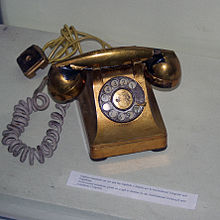
At the beginning of 1959 United States companies owned about twoscore percent of the Cuban sugar lands—virtually all the cattle ranches—90 percent of the mines and mineral concessions—fourscore percent of the utilities—practically all the oil manufacture—and supplied two-thirds of Cuba'south imports.
—John F. Kennedy[49]
In a fashion that antagonized the Cuban people, the U.S. government used its influence to accelerate the interests of and increase the profits of the private American companies, which "dominated the isle's economy".[49] By the belatedly 1950s, U.S. financial interests owned 90% of Cuban mines, lxxx% of its public utilities, l% of its railways, forty% of its sugar production and 25% of its banking concern deposits—some $one billion in full.[52] According to historian Louis A. Pérez Jr., author of the volume On Becoming Cuban, "Daily life had developed into a relentless degradation, with the complicity of political leaders and public officials who operated at the behest of American interests."[52] Every bit a symbol of this human relationship, ITT Corporation, an American-endemic multinational telephone company, presented Batista with a Gilded Telephone, every bit an "expression of gratitude" for the "excessive phone rate increase", at least co-ordinate to Senator John F. Kennedy, that Batista granted at the urging of the U.S. government.[49] [ non-primary source needed ]
Earl E.T. Smith, quondam U.S. Ambassador to Cuba, testified to the U.S. Senate in 1960 that, "Until Castro, the U.S. was then overwhelmingly influential in Cuba that the American ambassador was the second most important human, sometimes even more important than the Cuban president."[62] In improver, near "all assistance" from the U.S. to Batista'due south government was in the "form of weapons assistance", which "merely strengthened the Batista dictatorship" and "completely failed to accelerate the economical welfare of the Cuban people".[49] [ non-primary source needed ] Such actions subsequently "enabled Castro and the Communists to encourage the growing conventionalities that America was indifferent to Cuban aspirations for a decent life."[49] [ not-chief source needed ]
According to historian and writer James S. Olson, the U.S. government substantially became a "co-conspirator" in the arrangement because of Batista's stiff opposition to communism, which, in the rhetoric of the Cold War, seemed to maintain business organization stability and a pro-U.S. posture on the isle.[9] Thus, in the view of Olson, "The U.S. government had no difficulty in dealing with him, fifty-fifty if he was a hopeless despot."[nine] On Oct 6, 1960, Senator John F. Kennedy, in the midst of his entrada for the U.Southward. presidency, decried Batista'southward human relationship with the U.Due south. government and criticized the Eisenhower administration for supporting him:
Fulgencio Batista murdered twenty,000 Cubans in seven years ... and he turned Democratic Cuba into a consummate constabulary country—destroying every individual liberty. Yet our aid to his authorities, and the ineptness of our policies, enabled Batista to invoke the name of the United States in support of his reign of terror. Administration spokesmen publicly praised Batista—hailed him as a staunch ally and a proficient friend—at a time when Batista was murdering thousands, destroying the last vestiges of freedom, and stealing hundreds of millions of dollars from the Cuban people, and nosotros failed to press for free elections.[49]
Batista, Fidel Castro and the Cuban Revolution [edit]

I believe that there is no country in the world including whatever and all the countries under colonial domination, where economic colonization, humiliation and exploitation were worse than in Cuba, in office owing to my state's policies during the Batista government. I canonical the proclamation which Fidel Castro made in the Sierra Maestra, when he justifiably chosen for justice and specially yearned to rid Cuba of corruption. I volition even go further: to some extent it is as though Batista was the incarnation of a number of sins on the role of the Us. Now we shall have to pay for those sins. In the affair of the Batista authorities, I am in understanding with the first Cuban revolutionaries. That is perfectly clear.
On July 26, 1953, simply over a year later Batista's second coup, a small-scale grouping of revolutionaries attacked the Moncada Barracks in Santiago. Government forces hands defeated the attack and jailed its leaders, while many others fled the state. The primary leader of the attack, Fidel Castro, was a immature attorney who had run for parliament in the canceled 1952 elections. Although Castro was never officially nominated, he felt that Batista's coup had sidetracked what would have been a promising political career for him.[64] In the wake of the Moncada assault, Batista suspended constitutional guarantees and increasingly relied on law tactics in an endeavour to "frighten the population through open displays of brutality."[30]
Batista held an election in 1954, running as the candidate of a political coalition that included the Progressive Action Political party, the Radical Matrimony Party and the Liberal Party.[65] [ page needed ] The opposition divided into abstentionists and electoralists. The abstentionists favored boycotting the elections regardless of the circumstances in which they were held, whereas the electoralists sought certain rights and guarantees to participate.[66] [ page needed ] The CIA had predicted that Batista would use whatever means necessary to ensure he won the election. Batista lived upwardly to their expectations, utilizing fraud and intimidation to secure his presidency. This led well-nigh of the other parties to cold-shoulder the elections.[67] Former President Ramón Grau San Martín, leading the electoralist factions of the Cuban Revolutionary Party, participated through the political entrada merely withdrew from the entrada days before ballot mean solar day, charging that his supporters had been terrorized.[68] [ page needed ] Thus Batista was elected president with the support of 45.6% of registered voters. Despite the boycott, Grau received the back up of six.8% of those who voted. The remaining voters abstained.[69] [ page needed ]
Past late 1955, student riots and anti-Batista demonstrations had become frequent, and unemployment became a problem as graduates entering the workforce could not find jobs.[70] [71] These were dealt with through increasing repression. All youth were seen equally suspected revolutionaries.[72] Due to its continued opposition to Batista and the big amount of revolutionary activity taking identify on its campus, the University of Havana was temporarily closed on November 30, 1956 (it did non reopen until 1959 under the get-go revolutionary government). On March 13, 1957, pupil leader José Antonio Echeverría was killed by police outside Radio Reloj in Havana later on announcing that Batista had been killed in a educatee assault on the Presidential Palace. In reality, Batista survived, and the students of the Federation of University Students (FEU) and the Directorio (DR) who led the set on were killed in the response by the military machine and police force. Castro quickly condemned the set on, since July 26 Movement had not participated in it.[73] [ folio needed ]
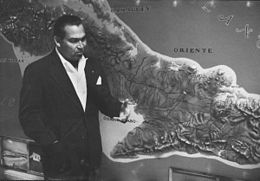
In April 1956, Batista called popular military leader Col. Ramón Barquín back to Cuba from his post as military attaché to the U.s.a.. Believing Barquín would support his rule, Batista promoted him to General.[74] However, Barquín's Conspiración de los Puros (Conspiracy of the Pure) was already underway and had already progressed too far. On Apr half dozen, 1956, Barquín led hundreds of career officers in a coup attempt, just was frustrated by Lieutenant Ríos Morejón, who betrayed the plan. Barquín was sentenced to solitary solitude for eight years on the Island of Pines, while some officers were sentenced to death for treason.[74] Many others were allowed to remain in the military without reprimand.[75] [ page needed ]
The purge of the officer corps contributed to the inability of the Cuban regular army to successfully combat Castro and his guerrillas.[74] [76] Batista's police responded to increasing popular unrest by torturing and killing immature men in the cities. However, his army was ineffective confronting the rebels based in the Sierra Maestra and Escambray Mountains.[30] Another possible explanation for the failure to crush the rebellion was offered by writer Carlos Alberto Montaner: "Batista does not finish Fidel out of greed ... His is a regime of thieves. To have this small guerrilla ring in the mountains is to his advantage, so that he tin can gild special defense expenditures that they tin steal."[30] Batista's rule became increasingly unpopular among the population, and the Soviet Marriage began to secretly support Castro.[77] Some of Batista's generals also criticized him in later years, saying that Batista's excessive interference in his generals' military machine plans to defeat the rebels hampered Army morale and rendered all operations ineffective.[75]
It is articulate that counter-terror became the strategy of the Batista government. Information technology has been estimated that possibly equally many as 20,000 civilians were killed.[78]

Batista'south soldiers executing a rebel by firing squad in 1956.
In an effort to get together information nigh Castro'south army, Batista's hole-and-corner police pulled in people for questioning. Many innocent people were tortured by Batista'south police, while suspects, including youth, were publicly executed equally a warning to others who were because joining the insurgency. Additionally, "Hundreds of mangled bodies were left hanging from lamp posts or dumped in the streets in a grotesque variation of the Spanish colonial practise of public executions."[72] The brutal beliefs backfired and increased support for the guerrillas. In 1958, 45 organizations signed an open letter supporting July 26 Movement, amidst them national bodies representing lawyers, architects, dentists, accountants, and social workers. Castro, who had originally relied on the back up of the poor, was at present gaining the backing of the influential centre classes.[ citation needed ]
The United States supplied Batista with planes, ships, tanks and the latest engineering science, such as napalm, which he used against the insurgency. However, in March 1958, the U.Due south. appear it would end selling arms to the Cuban government.[79] Soon after, the U.S. imposed an arms embargo, further weakening the government's position,[80] [ folio needed ] although land owners and others who benefited from the government continued to support Batista.[35]
Elections were scheduled for June 1958, as required by the Constitution, simply were delayed until November 1958, when Castro and the revolutionaries called for a general strike and placed several bombs in civilian areas of the country. Three main candidates ran in the elections: Carlos Márquez Sterling of the Political party of the Free People, one-time President Ramón Grau San Martín of the Cuban Revolutionary Party-Authentic, and Andrés Rivero Agüero of the authorities coalition. According to Carlos Márquez Sterling, all three were threatened by Castro, and several assassination attempts were made on both Ramón Grau San Martín and Carlos Márquez Sterling. On Ballot Day, estimates on the turnout range from 30 to 50% in the areas where voting took place, which did not include parts of Las Villas and Oriente, which were controlled by Castro.[81] [ folio needed ] Márquez Sterling besides stated that the initial results were favorable to him, simply the armed services ordered the counting to end equally they changed the actual ballots for fraudulent ones.[81] However, Grau San Martín, equally he had previously washed in the 1954 elections, withdrew his candidacy inside a few hours of the election day. Batista declared Rivero Agüero the winner. On December 11, 1958, U.S. Ambassador Earl Smith visited Batista at his hacienda, Kuquine. There, Smith informed him that the United states of america could no longer support his government. Batista asked if he could go to his firm in Daytona Beach. The administrator denied the request and suggested that he seek asylum in Spain instead.[ citation needed ]
On Dec 31, 1958, at a New year'due south Eve party, Batista told his cabinet and peak officials that he was leaving the state. Later on seven years, Batista knew his presidency was over, and he fled the island in the early morning.[82] At iii:00 a.m. on January 1, 1959, Batista boarded a plane at Camp Columbia with twoscore of his supporters and firsthand family unit members[83] and flew to Ciudad Trujillo in the Dominican Republic. A 2d plane flew out of Havana afterwards in the night, carrying ministers, officers and the Governor of Havana. Batista took forth a personal fortune of more than $300 meg that he had amassed through graft and payoffs.[84] Critics accused Batista and his supporters of taking as much as $700 one thousand thousand in fine art and greenbacks with them as they fled into exile.[85] [86]
As news of the fall of Batista'south government spread through Havana, The New York Times described jubilant crowds pouring into the streets and automobile horns honking. The black and ruddy flag of July 26 Move waved on cars and buildings. The temper was chaotic. On January viii, 1959, Castro and his army rolled victoriously into Havana.[87] Already denied entry to the United States, Batista sought aviary in Mexico, which also refused him. Portugal'due south leader António Salazar allowed him to settle at that place on the condition that he completely abjure from politics.[88]
Historians and main documents approximate betwixt hundreds and xx,000 Cubans were killed under the Batista regime.[14] [xiii] [16] [17] [eighteen] [89] [90]
Personal life [edit]

Batista and his wife Marta Fernández Miranda at breakfast in the Presidential Palace in April, 1958.
Marriages and children [edit]
Batista married Elisa Godínez y Gómez (1900–1993) on July 10, 1926. They had three children: Mirta Caridad (1927–2010), Elisa Aleida (born 1933), and Fulgencio Rubén Batista Godínez (1933–2007).[91] By all accounts, she was devoted to him and their children throughout their marriage, and their daughter remembered them as a "happy, immature couple" until their sudden divorce. Much to her surprise, he divorced her in October 1945 against her will in order to marry his longtime mistress Marta Fernandez Miranda.
He married Marta Fernández Miranda (1923–2006) on November 28, 1945, presently later on his divorce became final, and they had five children: Jorge Luis (built-in 1942), Roberto Francisco (built-in 1947), Carlos Manuel (1950–1969), Fulgencio José (born 1953) and Marta María Batista Fernández (born 1957).
[edit]
Batista was an inveterate philanderer who engaged in numerous extramarital affairs throughout his first matrimony. He cheated on his get-go wife with multiple women, and his children eventually became aware of his relationships.[92] [ page needed ] His start wife, who supported her hubby throughout his political career and found his philandering humiliating, never considered divorce and tolerated his multiple affairs.[92] [ folio needed ] All the same, Batista became enamored with the much younger Marta Fernandez Miranda, who became his longtime mistress. He filed divorce papers shortly before his first grandchild was built-in. His offset wife and their children were astounded and devastated by the divorce.[93] [ folio needed ]
In 1935, he fathered an illegitimate girl, Fermina Lázara Batista Estévez, whom he supported financially.[86] [94] Biographers propose that Batista may have fathered several more than children out of wedlock.
Death [edit]
After he fled to Portugal, Batista lived in Madeira, then later in Estoril. He died of a heart attack on Baronial half-dozen, 1973, at Guadalmina, Kingdom of spain,[19] two days before a team of assassins from Castro's Republic of cuba allegedly were planning to assassinate him.[30]
Marta Fernández Miranda de Batista, Batista's widow, died on October ii, 2006.[85] Roberto Batista, her son, says that she died at her abode in West Palm Beach, Florida.[86] She had suffered from Alzheimer'southward disease.[86] She was cached with her hubby and son in the Cementerio Sacramental de San Isidro in Madrid.
In pop culture [edit]
Actors who have portrayed Batista in film include Tito Alba in The Godfather Part Two (1974), Wolfe Morris in Cuba (1979)[95] and Juan Fernández de Alarcón in The Lost Urban center (2005).[96]
In literature and movies, Batista's regime is unremarkably referred to as the "greens" (opposite the Communist "reds"), because of the green uniforms his soldiers wore.[ citation needed ]
In Cuban mail service-revolution books, documentaries and movies Batista's troops were are too referred to as the "helmets" or "casquitos" (in Spanish), considering of the helmets they used.
In Ubisoft'due south "Far Cry 6" it has been confirmed that the antagonist dictator "El Presidente" Antón Castillo was heavily based on Batista.
Books written by Batista [edit]
- Estoy con el Pueblo (I am With the People), Havana, 1939
- Respuesta, Manuel León Sánchez Due south.C.L., Mexico City, 1960
- Piedras y leyes (Stones and Laws), United mexican states City, 1961
- Cuba Betrayed, Vantage Press, New York, 1961
- To Rule is to Foresee, 1962
- The Growth and Reject of the Cuban Republic, Devin-Adair Visitor, New York, 1964
Source: Works past or about Fulgencio Batista in libraries (WorldCat catalog)
References [edit]
- ^ "Batista". Random House Webster's Unabridged Lexicon.
- ^ a b Cino, Luis (March 13, 2006). "Rubén el terrible" [Rubén the terrible]. Cubanet. Coral Gables, FL: CubaNet News, Inc. Archived from the original on November 30, 2007. Retrieved September 30, 2017.
En las actas del juzgado de Banes siguió siendo legalmente Rubén Zaldívar hasta que en 1939, al ser nominado a la candidatura presidencial, se descubrió que la inscripción de nacimiento de Fulgencio Batista no existía. Conseguirla le costó postergar la presentación de su candidatura y quince mil pesos para pagar al juez." – "In the minutes of the courthouse at Banes he remained legally being Rubén Zaldívar until 1939, when, nominated to the presidential candidacy, it was discovered that Fulgencio Batista'southward nativity document did not exist. To obtain information technology cost him the postponing the presentation of his candidacy and fifteen grand pesos to pay the [local] estimate.
- ^ "Elections and Events 1935-1951 – The Library". Libraries.ucsd.edu. Archived from the original on January 12, 2014. Retrieved August 18, 2014.
- ^ Argote-Freyre, Frank (2006). Fulgencio Batista. Vol. 1. New Brunswick, N.J.: Rutgers University Press. p. 50. ISBN978-0-8135-3701-half dozen.
- ^ Wright, Robert; Wylie, Lana, eds. (2009). Our Place in the Sun: Canada and Cuba in the Castro Era. University of Toronto Press. p. viii. ISBN978-0-8020-9666-1 . Retrieved July six, 2013.
- ^ Cavendish, Richard (March 2002). "General Batista Returns to Ability in Cuba". History Today. Vol. 52, no. 3. London: History Today Ltd. Retrieved September 30, 2017.
- ^ Guerra, Lillian (2010). Grandin, Greg; Joseph, Gilbert K. (eds.). Across Paradox. A Century of Revolution. American Encounters/Global Interactions. Durham, NC: Duke University Press. pp. 199–238. ISBN978-0-8223-4737-eight.
- ^ Fidel: The Untold Story. (2001). Directed by Estela Bravo. Kickoff Run Features. (91 min). Viewable clip. "Batista'southward forces were trained past the United States, which as well armed them with tanks, artillery, and aircraft."
- ^ a b c d Historical Dictionary of the 1950s, by James Stuart Olson, Greenwood Publishing Grouping, 2000, ISBN 0-313-30619-2, pp. 67–68.
- ^ Fidel: The Untold Story. (2001). Directed by Estela Bravo. First Run Features. (91 min). Viewable clip.
- ^ Havana Nocturne: How the Mob Owned Cuba and So Lost Information technology to the Revolution, past T.J. English language, William Morrow, 2008, ISBN 0-06-114771-0.
- ^ CIA (1963). Political Murders in Cuba -- Batista Era Compared with Castro Authorities
- ^ a b Wickham-Crowley, Timothy P. (1990). Exploring Revolution: Essays on Latin American Insurgency and Revolutionary Theory. Armonk and London: M.East. Sharpe. P. 63 "Estimates of hundreds or maybe about a g deaths due to Batista's terror are also supported past comments made past Fidel Castro and other Batista critics during the war itself."
- ^ a b Guerra, Lillian (2012). Visions of Power in Republic of cuba: Revolution, Redemption, and Resistance, 1959–1971. Chapel Colina: Academy of N Carolina Printing. p. 42 "The likely total was probably closer to three to four thou."
- ^ Disharmonize, Order, and Peace in the Americas, past the Lyndon B. Johnson School of Public Diplomacy, 1978, p. 121. "The US-supported Batista authorities killed 20,000 Cubans"
- ^ a b Invisible Latin America, by Samuel Shapiro, Ayer Publishing, 1963, ISBN 0-8369-2521-ane, pg 77. "All told, Batista's second dictatorship cost the Cuban people some 20,000 dead"
- ^ a b The World Guide 1997/98: A View from the Due south, by Academy of Texas, 1997, ISBN one-869847-43-one, pg 209. "Batista engineered yet another coup, establishing a dictatorial regime, which was responsible for the expiry of 20,000 Cubans."
- ^ a b The Third Globe in Perspective, past H.A. Reitsma & J.Grand.One thousand. Kleinpenning, ISBN 0-8476-7450-9, pg 344. "Under Batista at least 20,000 people were put to death."
- ^ a b "Batista Dies in Espana at 72". The New York Times. August 7, 1973.
- ^ "Mambí Army" Data Base.
- ^ Sierra, Jerry A. "Fulgencio Batista, from regular army sergeant to dictator". www.historyofcuba.com.
- ^ Havana Past Brendan Sainsbury [1].
- ^ Fidel Castro'south Road to Power, Volume i.
- ^ Hugh Thomas, folio 391 "Cuba" ISBN 0 330 48487 7.
- ^ Batista y Zaldívar, Fulgencio Archived May 23, 2010, at the Wayback Car by Aimee Estill, Historical Text Archive.
- ^ a b "Development of a Dictator". Time. June 12, 1944. Archived from the original on December 14, 2008. Retrieved May 3, 2010.
- ^ La piel de la memoria by René Dayre Abella.
- ^ Hugh Thomas, folio 392 "Cuba" ISBN 0 330 48487 vii.
- ^ Hugh Thomas, folio 390 "Cuba" ISBN 0 330 48487 7.
- ^ a b c d e f g h i American Experience: Fulgencio Batista by PBS.
- ^ a b Foreign Relations of the Usa: Diplomatic Papers, 1933. The American Republics: Volume 5, p. 384. http://images.library.wisc.edu/FRUS/EFacs/1933v05/reference/frus.frus1933v05.i0010.pdf
- ^ a b Frank Argote-Freyre. Fulgencio Batista: Volume ane, From Revolutionary to Strongman. Rutgers University Press, New Jersey.
- ^ Leslie Bethell (March 26, 1993). Cuba. ISBN978-0-521-43682-iii.
- ^ a b c Julia East. Sweig (October 2004). Inside the Cuban Revolution. ISBN978-0-674-01612-5.
- ^ a b Jorge I. Domínguez. Cuba. p. xc.
- ^ a b Jorge I. Domínguez (1879). Cuba. Impr. "El Telegrafo,".
- ^ "Plainly Talk in Castilian", Time, December 28, 1942, Retrieved March 2, 2010
- ^ "Batista's Boost", Time, January xviii, 1943, Retrieved March 2, 2010.
- ^ "See".
- ^ United States Department of State (1944), "Foreign relations of the U.s.a. : diplomatic papers, 1944", The American Republics, University of Wisconsin Digital Collections, vol. VII, p. 910, retrieved April 8, 2010
- ^ Biography of Fulgencio Batista—Fulgencio Batista Profile Most.com.
- ^ [two] [ dead link ]
- ^ Morales Dominguez, Esteban; Prevost, Gary (2008). Usa-Cuban Relations: A Critical History. Rowman & Littlefield. p. 34. ISBN978-0739124437 . Retrieved Nov 30, 2016.
- ^ "Cuba: Elections and Events 1952-1959". Collections of Distinction: Latin American Elections Statistics. The Library, UC San Diego. Retrieved November 30, 2016.
- ^ This date is given in many sources although at that place is none that seemed to be clearly definitive. The closest is a recommendation from US Secretary of State Dean Acheson to President Truman on March 24 recommending recognition on that date: Acheson, Dean (March 24, 1952). "Continuation of Diplomatic Relations with Cuba". Role of the Historian of the Usa Department of State. U.s.a. Department of Land. Retrieved March 9, 2017.
- ^ The Dynamics of Earth Power: A Documentary History of the United States Foreign Policy 1945-1973, by Arthur Meier Schlesinger, 1973, McGraw-Loma, ISBN 0070797293, p. 512.
- ^ "The Cuban revolution at 50: Heroic myth and prosaic failure". The Economist. December thirty, 2008.
- ^ a b Servando Gonzalez. The Clandestine Fidel Castro.
- ^ a b c d e f thou Remarks of Senator John F. Kennedy at Democratic Dinner, Cincinnati, Ohio, October vi, 1960 from the John F. Kennedy Presidential Library.
- ^ The Brink: Cuban Missile Crisis 1962, by David Detzer, Crowell, 1979, ISBN 0690016824, p. 17.
- ^ a b William Morgan: A Rebel "Americano" in Republic of cuba at The Cuban History, May 16, 2012.
- ^ a b c Earlier the Revolution by Natasha Geiling, Smithsonian Magazine, July 31, 2007.
- ^ Cuba Before the Revolution by Samuel Farber, Jacobin Magazine, September 6, 2015.
- ^ 'A Visit With Castro' by Arthur Miller, The Nation, 2003
- ^ Fulgencio Batista Archived May 14, 2013, at the Wayback Machine fun facts past History of Republic of cuba.
- ^ Havana Nocturne: How the Mob Owned Cuba and And then Lost It to the Revolution, by T.J. English, William Morrow, 2008, ISBN 0-06-114771-0, p. 15, 16, 20
- ^ Havana Nocturne: How the Mob Owned Cuba and So Lost Information technology to the Revolution, by T.J. English, William Morrow, 2008, ISBN 0-06-114771-0, p. 46-47.
- ^ Havana Nocturne: How the Mob Owned Cuba and Then Lost Information technology to the Revolution, by T.J. English, William Morrow, 2008, ISBN 0-06-114771-0, p. 132.
- ^ Cuban History, Architecture & Civilisation Archived July 20, 2011, at the Wayback Machine.
- ^ Fulgencio Batista: Cuban Dictator, 1901–1973 at U-Due south History.
- ^ Díaz-Briquets, Sergio & Pérez-López, Jorge F. (2006). Corruption in Republic of cuba: Castro and beyond. Academy of Texas Press. p. 77. ISBN978-0-292-71482-3.
{{cite volume}}: CS1 maint: uses authors parameter (link) - ^ Ernesto "Che" Guevara (World Leaders Past & Present), past Douglas Kellner, 1989, Chelsea House Publishers, ISBN 1-55546-835-vii, p. 66.
- ^ New Commonwealth, 14 Dec. 1963, Jean Daniel "Unofficial Envoy: An Celebrated Report from Two Capitals," page 16
- ^ Walsh, Daniel C. (2012). An Air War with Cuba. NC, U.s.: McFarland. p. v. ISBN978-0-7864-6506-4. Archived from the original on January 28, 2013.
- ^ Fulgencio Batista y Zaldivar. Respuesta: Primera Edición. México, D.F. Impresa Manuel León Sanchez. 1960.
- ^ Manuel Marquez-Sterling. Cuba 1952–1959: The True Story of Castro's Rising to Power. Wintergreen, Virginia. Kleiopatria Digital Printing. 2009.
- ^ Paterson, Thomas G. (1995). Contesting Castro: The United States and the Triumph of the Cuban Revolution. Oxford University Press. p. 25. ISBN978-0-xix-510120-1.
- ^ Antonio Lancis Sanchez. El proceso electoral de 1954. Havana, Republic of cuba. Ediciones Lex. 1955.
- ^ Mario Riero Hernandez. Cuba Politica. La Habana, Cuba. 1955.
- ^ Horowitz, Irving Louis (1988). Cuban communism. New Brunswick, N.J.: Transaction Books. p. 662. ISBN978-0-88738-672-5.
- ^ Thomas, Hugh (March 1971). Cuba; the Pursuit of Freedom. New York: Harper & Row. p. 1173. ISBN978-0-06-014259-9.
- ^ a b Invisible Latin America, by Samuel Shapiro, Ayer Publishing, 1963, ISBN 0-8369-2521-one, p. 77.
- ^ Historia de Cuba: Desde Colon hasta Castro. Carlos Márquez Sterling. Miami, Florida. 1963.
- ^ a b c Sullivan, Patricia (March vi, 2008). "Ramón Thou. Barquín, 93; Led Failed '56 Coup in Republic of cuba". The Washington Postal service . Retrieved March 31, 2008.
- ^ a b Francisco Tabernilla Palmero and Gabriel E. Taborda. Palabras esperadas: Memorias de Francisco H. Tabernilla Palmero. Ediciones Universales. Miami, Florida. 2009.
- ^ DePalma, Anthony (March half dozen, 2008). "Ramón Barquín, Cuban Colonel, Dies at 93". The New York Times . Retrieved March 31, 2008.
- ^ Timothy P. Wickham-Crowley. Guerrillas and revolution in Latin America. p. 189.
- ^ Violence in America: Historical and Comparative Perspectives—A Report to the National Committee on the Causes and Prevention of Violence Volume 2, U.S. Government Press Office, 1969, p. 582.
- ^ Ernesto "Che" Guevara (Earth Leaders Past & Nowadays), by Douglas Kellner, 1989, Chelsea House Publishers, ISBN ane-55546-835-vii, p. 45.
- ^ Louis A. Pérez. Republic of cuba and the The states.
- ^ a b Carlos Márquez Sterling. Memorias de united nations estadista. Ediciones Universales. Miami, Florida. 2005.
- ^ Audio: Recalling Castro's Ascension – And CIA Reaction by Tom Gjelten, NPR Morning Edition, January 1, 2009.
- ^ Cuba, Hugh Thomas, ISBN 0-330-48487-7, p. 687.
- ^ Alarcón, Ricardo. "The Long March of the Cuban Revolution." Monthly Review 60, no. 8 (January 1, 2009): 24. doi:ten.14452/mr-060-08-2009-01_2.
- ^ a b O'Meilia, Tim (October four, 2006). "Widow of Cuban dictator Batista dies in WPB". Palm Beach Post.
- ^ a b c d "Widow of Cuban strongman Batista dies". October 5, 2006. Retrieved March 25, 2016.
- ^ "Castro: The Swell Survivor". BBC News. October 2000. Retrieved May 15, 2006.
- ^ HOROWITZ, Irving Louis & SUCHLICKI, Jaime, Cuban Communism: 1959-2003, New Jersey, Transaction Publishers, 11th ed., 2003, p. 34.
- ^ Fidel: The Untold Story. (2001). Directed by Estela Bravo. First Run Features. (91 min). Viewable clip. "An estimated 20,000 people were murdered by authorities forces during the Batista dictatorship."
- ^ Conflict, Gild, and Peace in the Americas, past the Lyndon B. Johnson School of Public Affairs, 1978, p. 121. "The U.s.a.-supported Batista regime killed twenty,000 Cubans".
- ^ "Son of quondam Cuban leader dies" [ permanent dead link ] . Pensacola News Periodical. November 9, 2007. [ dead link ]
- ^ a b Argote-Freyre, Frank (April 21, 2006). Fulgencio Batista: The Making of a Dictator . Rutgers University Press. ISBN9780813541006.
divorce.
- ^ Argote-Freyre, Frank (April 21, 2006). Fulgencio Batista: The Making of a Dictator . Rutgers Academy Press. ISBN9780813541006.
tolerated information technology.
- ^ "Batista Will and $iii,270,000 Reported Found". The News Tribune. Fort Pierce, FL. Associated Press. January 25, 1959. p. 11.
- ^ Republic of cuba at IMDb
- ^ The Lost City at IMDb
External links [edit]
- Fulgencio Batista from The History of Cuba
- Fulgencio Batista from The Latin American Studies Organisation
- What Castro Establish by Ana Simo, The Gully (magazine)
- January ane, 1959: "Cuban Dictator Batista Falls From Power" by The History Channel
Source: https://en.wikipedia.org/wiki/Fulgencio_Batista
0 Response to "Batista Stops Power Again and Is in Charge of Oppressive and Corrupt of Regime"
Post a Comment